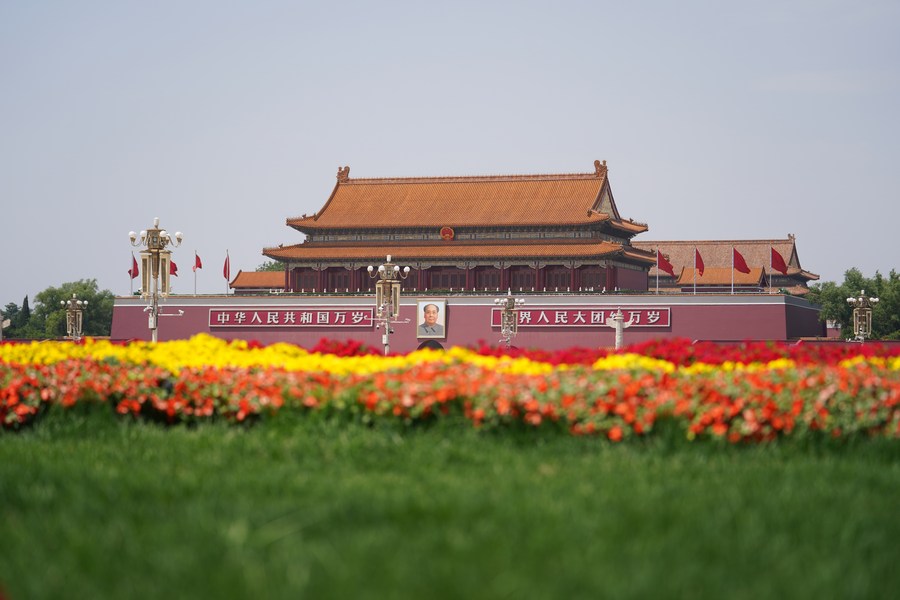
Tian'anmen Square Complex
Introduction
The Tian'anmen Square Complex is a significant landmark situated in the southern-central section of the Beijing Central Axis. This extensive and flat area, noted for hosting national ceremonies, was developed from the 1950s to the 1970s. As part of the larger Beijing Central Axis, the complex is an integral element of China's architectural and cultural heritage.
At the heart of the square stands the Monument to the People's Heroes, a classical Chinese stele that underscores the traditional Chinese principle of "choosing the center." This monument serves as the focal point around which other notable structures are symmetrically arranged. The National Museum of China and the Great Hall of the People, located on the east and west sides of the square respectively, mirror each other with their flat roofs and colonnaded facades, further emphasizing the centrality of the Monument to the People's Heroes.
The Tian'anmen Square Complex harmonizes with the traditional cityscape of the Beijing Central Axis, forming a crucial part of the third spatial ensemble of this historic urban planning masterpiece. Its design reflects the principles of balance and symmetry, which are central to traditional Chinese aesthetics and urban planning.
History
Early Conception and Construction
The conception of the Tian'anmen Square Complex can be traced to the broader planning efforts of the Beijing Central Axis, which began in the 13th century and was shaped significantly in the 16th century. Originally, the axis was designed to govern the overall layout of Beijing, with a focus on imperial palaces, gardens, and sacrificial buildings, thereby influencing the architectural practices of traditional Chinese cities for over two millennia.
The square itself was constructed as part of the post-1949 urban development in Beijing. The construction of the Monument to the People's Heroes commenced in 1952 and was completed in 1958. This monument, one of the largest in China's history, embodies the revolutionary spirit and commemorates key events from 1840 to 1949, depicted in large relief sculptures on its base.
Major Renovations
Throughout its history, the Tian'anmen Square Complex has seen several renovations to enhance its functionality and aesthetic appeal. These renovations have been guided by the need to preserve its historical significance while accommodating modern uses. The Great Hall of the People, completed in 1959, is a key example of such efforts. It serves as the venue for the China National People's Congress meetings and other significant political and diplomatic events.
The complex also underwent significant changes to accommodate public access and national ceremonies. One such major change was the establishment of the Mao Zedong Memorial Hall in 1977, shortly after Chairman Mao's passing in 1976. This hall, located at the southern end of the square, houses Mao's remains and is an important site for visitors who wish to pay their respects.
Key Structures
The Great Hall of the People
West of the Square is the Great Hall of the People. This building, erected in 1959, is the site of the China National People's Congress meetings and provides an impressive site for other political and diplomatic activities. Twelve marble posts are in front of the Hall which has three parts -- the Central Hall, the Great Auditorium and a Banqueting Hall. The floor of the Central Hall is paved with marble and crystal lamps hang from the ceiling. The Great Auditorium behind the Central Hall seats 10,000. The Banqueting Hall is a huge hall with 5,000 seats.
The Monument to the People's Heroes
The granite Monument to the People's Heroes is just at the center of the Tian'anmen Square, directly upon the central axis of the old city. The construction started in 1952 and was completed in 1958. The magnificent Monument is 37.94 meter in height and built with over 17,000 pieces of marble and granite. It is the largest monument in China's history. "The People's Heroes are Immortal" written by late-Chairman Mao is engraved on the monument. Two rows of white marble railings enclose the monument, simple and beautiful.
The base of the monument is decorated with eight unusually large relief sculptures. They depict chronological events during the revolutionary period from 1840 to 1949. The sequence begins on the eastern side and moves clockwise around the base. These are the events shown in the carvings.
On the eastern side we begin with destruction of Opium at Humen in Guangdong province from 1839-1842. Next is the Jintian Uprising in Taiping Heavenly Kingdom in Guangxi from 1851-1864. On the next side facing south we see the 1911 Revolution in Hubei province, the May 4th Movement in Beijing in 1919 and the May 30th Movement in Shanghai in 1925. To the west the pictures are the Nanchang Uprising in Jiangxi in 1927 and the War of Resistance against Japan from 1937-1945. On the last side we see Grain for the Front; the Successful Crossing of the Yangtze River in 1949 and, last but not least, a picture entitled "Long live the Liberation Army!"
China National Museum
Another important place for tourists to visit is the China National Museum at the east side of the Square. It just came into existence in 2003 and is a combination of Chinese History Museum and Chinese Revolutionary Museum. This National Museum faces the Great Hall of the People. Inside the Chinese Revolutionary Museum are a lot of material objects, pictures, books and models to present the development of modern China. The Chinese History Museum shows a large number of cultural relics illustrating the long history and glorious culture of China from 1,700,000 years ago to 1921 when the last emperor left the throne.
Mao Zedong Memorial Hall
Located at the southern end of Tian'anmen Square just behind the Monument to the Heroes of the People is the hall where the remains of Chairman Mao are kept. Many Chinese show deep respect when confronted with the physical presence of Mao.
It is a relatively new structure. Construction began in 1976 after the death of our leader Mao Zedong and completed only a year later in 1977. Chairman Mao was born on December 26, 1893, in Hunan Province. He passed away in Beijing on September 9, 1976, at the age of 83.
The hall is 260 meters long from north to south, 220 meters wide from east to west and 33.6 meters high. Like the Monument to the Heroes of the People, it is also located on the central axis of old Beijing. It has five parts, namely, the Courtyard, the Memorial Hall, the North Hall, the Viewing Hall and the South Hall.
Cultural Significance
Symbolic Importance
The Tian'anmen Square Complex holds immense symbolic importance in Chinese culture and history. It represents the political and cultural heart of Beijing, embodying the principles of traditional Chinese urban planning. The Monument to the People's Heroes, with its engravings and relief sculptures, is a testament to the country's revolutionary history and the sacrifices made by many for national progress.
The complex's alignment along the Beijing Central Axis further enhances its cultural significance, highlighting its role as a central point of national identity and heritage. This alignment with the Axis reflects the enduring influence of Confucian ideals and the concept of "neutrality and harmony," which have long been integral to Chinese civilization.
Role in National Celebrations
Tian'anmen Square is a focal point for national celebrations and significant events in China. It is renowned for hosting large-scale ceremonies, including the annual National Day celebrations, military parades, and other state functions. These events underscore the square's role as a symbol of national pride and unity.
The square's large open space and central location make it an ideal venue for gatherings, allowing it to accommodate thousands of visitors and participants. The presence of significant structures such as the Great Hall of the People and the Mao Zedong Memorial Hall further enhances its status as a site of national importance.
Tourism
Visitor Information
Tian'anmen Square is a major tourist attraction in Beijing, drawing millions of visitors each year. The square is easily accessible by public transportation, with several nearby metro stations and bus routes. Visitors are encouraged to explore the various historical and cultural sites within the complex, including the Monument to the People's Heroes, the Great Hall of the People, and the National Museum of China.
The square is open to the public, and visitors can attend flag-raising ceremonies held daily. Security checks are conducted for all visitors entering the square, ensuring a safe and orderly experience.
Nearby Attractions
In addition to the attractions within the Tian'anmen Square Complex, there are several other notable sites nearby that visitors may wish to explore. The Forbidden City, located just north of the square, is a UNESCO World Heritage Site and one of the most well-preserved ancient palaces in the world. It offers a glimpse into China's imperial past with its stunning architecture and vast collections of historical artifacts.
The Temple of Heaven, another significant historical site, is situated a short distance away. Known for its beautiful gardens and iconic circular temple, it is an important cultural and spiritual site in Beijing. Visitors can also explore Jingshan Hill, which offers panoramic views of the Forbidden City and the surrounding cityscape.
Overall, the Tian'anmen Square Complex is not only a place of great historical and cultural significance but also a central hub for tourism in Beijing. Its rich history, architectural grandeur, and symbolic importance make it a must-visit destination for anyone exploring China's capital.








